5. THE FINGERS AND THUMBS
手指与大拇指
Time to recap.
If you are feeling overwhelmed by so much information, go back over the previous chapters and identify the main palm features listed in each chapter.
For each major feature, read the definition of the line or mount, but focus only on the characteristics of a well-developed line or mount.
Using deduction, you can easily work out from that what an excessive feature would mean and an undeveloped one.
Much less to memorize at this stage.
ADDING FINGERS AND THUMBS TO THE PICTURE
Study all the hands you can, and make a quick assessment of their fingers and thumbs, especially if a big person has short, small fingers or a small person has longer, larger ones or prominent ones.
Short fingers indicate an active person who can absorb information rapidly but who wants to achieve everything at once.
In contrast, a more patient long-fingered person thinks before speaking or acting.
I am focusing on the fingers and thumbs, especially on the Active hand where the effects of life are most clearly seen.
However, you will see differences on the Inactive hand as hand sizes and shapes certainly don’t exactly match, any more than individual foot sizes do.
Indeed, if you see an issue on the Active hand, looking at the less-developed hand may offer a clue about potentials we are not using or, conversely, where we have gone off-track from the blueprint.
Once you consider the fingers and thumbs, you can often instantly see how a weak finger can be compensated for by its mount or indeed a line on the hand that is well developed.
If relative finger sizes seem hard to assess because of a low-set thumb or little finger, use a piece of thread or a small ruler to measure finger sizes.
WHERE TO BEGIN
Phalanges (this is the plural of phalanx), the three bones of the fingers and thumbs themselves, manifest the energy of their own mount (the thumb is linked to the mount of Venus) and tend to represent, from top (i.e., the tip) to bottom: the first, mental abilities/thought processes/intuitive reasoning; the second, the application of those processes to work, money, and any formal aspects of your life such as study; and the third, all practical everyday matters.
You can assess the amount of energy and area of life in which the energy is manifested, emanating from the mounts, by the relative lengths and sizes of the finger/thumb phalanges, as well as the mount size itself.
THE FINGERS
Consider the lengths of the fingers in comparison with other fingers, and then assess the relative lengths of the individual finger phalanges.
You may find relative lengths easier to check on the back of the hand.
Individual straight fingers are considered ideal.
Jupiter
The pointing finger that indicates what is wanted in life, the Jupiter index finger has the same qualities as the mount of the same name, and strength in one can compensate for weakness in the other.
This is true of all four planetary fingers and thumbs with their corresponding mounts.
The Jupiter finger refers to the innate self/personality, ambition, self-confidence, leadership, altruism, authority, and good fortune.
The first Jupiter finger should be approximately the same size as the third Apollo finger, bringing balance, focus, and achievement of realistic aims.
• A JUPITER FINGER LONGER THAN THE APOLLO FINGER: A self-starter with powerful drives for worldly success, a natural but benign leader and good teacher/mentor.
Watch for excessive lines or markings on the Jupiter finger for potential burnout.
• EXTRA-LONG, ESPECIALLY IF FLESHY: Can be bombastic.
• A JUPITER FINGER SHORTER THAN THE APOLLO FINGER: May go along with others’ desires and opinions, especially in career; but in an older person, 50-plus, can transform this setback into wisdom to know when to act and when to wait.
• VERY SHORT JUPITER FINGER, ENDING BELOW THE MID-POINT OF THE TOP PHALANX OF THE SATURN FINGER: Pettiness and hiding behind authority figures.
Jupiter Phalanges
• LONG FIRST PHALANX: A charismatic leader who instinctively knows the right things to do and say to inspire others; self-confident and not needing approval of others.
• LONG SECOND PHALANX: A forceful leader, very ambitious who is unwilling to compromise and less likely to consult others; can be selfish if set on what seems the right course.
• SHORT SECOND PHALANX: Indicates interest in religion and traditional belief systems that grows through the years.
• LONG THIRD PHALANX: Successful practical matters in the everyday material world, as long as subject does not lose sight of original purpose; can be arrogant.
• SHORT THIRD PHALANX: Seeks personal happiness rather than worldly fulfillment.
Saturn
The second Saturn finger should be the longest finger and is the finger against which other fingers are measured.
It signifies our acquired character; responsibility; duty; conventional values and ideals; creating boundaries for self and against others; advancement through slow conventional ways, such as property or safe career; wisdom; and introspection.
• IF IT IS SIMILAR IN LENGTH TO FINGERS ON EITHER SIDE: Influenced by the meaning of the other fingers in priorities and values.
• LONG: High principles, serious in outlook, rarely relaxes or has fun.
• SHORT, COMPARED WITH JUPITER 1ST AND APOLLO FINGER 3RD: Finds taking personal initiative hard, happiest in controlled environment with well-defined rules and set career path.
Saturn Phalanges
• LONG FIRST PHALANX: Can be prone to pessimism and mistrust of others.
• LONG SECOND PHALANX: A traditional approach to life, good at property deals, very cautious about change; can have superiority complex.
• LONG THIRD OR BASE PHALANX: The gardener’s phalanx, good at anything to do with the land, animals, wildlife, or gardens.
Apollo
Apollo, the third ring finger, is ideally the same size as the first Jupiter finger.
It represents creativity, especially in the arts, desire for fame/recognition in the chosen field, scientific and technological gifts, and luck in money.
• LONG FINGER, REACHING BEYOND HALF-WAY OF TOP PHALANGE OF SATURN FINGER: Tendency to take chances in life, often called the Gambler’s finger; lucky in business and speculation, happy in own skin, sociable.
• SHORT FINGER, ENDING BELOW MID-POINT OF TOP PHALANGE OF SATURN: Prefers to imitate others rather than trusting own ideas, lacks inspiration and drive.
Apollo Phalanges
• LONGEST TOP PHALANX: Can reach heights of success creatively, even fame.
• LONGEST SECOND PHALANX: Creativity or creative thinking will be beneficial in any career path, natural love of beauty and dislike of messiness in home, charismatic.
• LONGEST THIRD PHALANX: Values material success, possessions and lifestyle, even if gets in debt to achieve.
Mercury
The Mercury little finger is normally parallel with the bottom of the top phalanx of the third finger.
Make allowances if Mercury finger is low-set on hand.
Use a thread to measure comparative sizes.
The Mercury finger represents persuasiveness in sales, ability to make money, communication through entertaining, dancing, singing, acting or advocacy, business and sales acumen, psychic powers, and healing.
• LONG FINGER, REACHING THE TOP OR PAST THE FIRST PHALANX OF APOLLO FINGER: Very confident socially and sexually, gifted in entrepreneurial ventures, tendency to override others’ opinions, can have an unconventional streak.
• SHORT FINGER: Does not believe in self, constantly searching for happiness and perfection, sexually timid, surprisingly good as a counselor.
• BENT-OVER: Attached to/dominated by family, especially parents, in later years can be bullied by children.
• TWISTED: Can be liberal with truth, manipulative, prefers sex to love.
Mercury Phalanges
• FIRST PHALANX GENERALLY LONGEST: Indicating naturally persuasive with words, salesperson supreme; or, in politics/law, can do well in entertainment.
• SECOND PHALANX, THE WRITER’S PHALANX: Can strengthen writer’s fork on Head line
• LARGER THIRD PHALANX: Good at money-making, business ventures, not always straightforward in financial dealings, better at small talk than meaningful emotions.
Leaning Fingers
Leaning fingers are influenced by those they lean toward.
• JUPITER FINGER LEANING TOWARD THUMB: Wants to be in charge of people/situations; if overdeveloped, Jupiter can be totally self-absorbed and selfish.
• JUPITER LEANING TOWARD SECOND SATURN FINGER: Seeks support, especially from authority figures; can also indicate co-dependency.
• SATURN LEANING TOWARD THIRD APOLLO FINGER: Many interests, but will not test talents in marketplace, can unconsciously sabotage own efforts.
• APOLLO LEANING TOWARD MERCURY: Verbally very persuasive, brilliant salesperson; also can be found in natural healers, those who care, and those who give up ambitions to care for sick or disabled family member.
THE THUMB
The thumb represents willpower and motivation, logic, perseverance, and competence.
If you can’t easily identify the third phalanx, calculate it reaching to the thumb’s semi-circular crease on the mount of Venus, usually encircled by Life line.
An average thumb length reaches the middle of the third phalanx of the first Jupiter finger, when you press your thumb to the side of the hand.
Use thread to assess comparative lengths if thumbs are low-set on the hands.
• SET HIGH ON HAND: A real goer, always ready for adventure and the unusual, including travel.
• LOW: Much more cautious about safety and advisability of actions, looks before leaps (if leaps at all).
• LARGE: Desperate to win but can ignore consequences of actions.
• EXCESSIVELY LARGE OR THICK IN COMPARISON WITH THE FINGERS: Dictatorial and may have issues with anger/self-control if challenged (check with Mars).
• BULBOUS IN ADDITION TO ABOVE THICKNESS: Very volatile and can react in an extreme fashion with little provocation.
• SHORT: More laissez-faire; but if challenged on matters of personal importance, will dig heels in.
• UNDERDEVELOPED: Allows others to dictate life, easily discouraged.
• SHORT: May be underachieving and need encouragement, may find self-regulation hard; see if other hand is the same.
• WAISTED: Sympathetic to others, aware of nonverbal signals.
• THIN: Opportunistic and calculating, not given to personal indulgences.
Thumb Angles and Suppleness of Thumb
Measure the suppleness of the thumb by the first phalange.
If the Inactive hand has a suppler thumb than the Active hand, there is potential to chill out more.
• RIGID: Practical, determined, strong ethics, unemotional.
good with money but can be
• SUPPLE (GET PERSON TO BEND THUMB): Generous, good-natured, but can be naïve toward the intentions of others and easy-come, easy-go with money.
• THE WIDER THE ANGLE BETWEEN THUMB AND JUPITER FINGER: The more open-hearted, generous, sometimes overgenerous, rushes in as rescuer where there is injustice (check Mars also).
• THUMB USUALLY 45-DEGREE ANGLE TO HAND: Open-minded, honest and tolerant, but won’t be a rebel.
• NARROW ANGLE: Focuses on local and family matters, indifferent to wider causes.
• HIGH-SET THUMB JOINS HAND VERY CLOSE TO FIRST JOINT OF JUPITER FINGER: Has trouble adapting to new situations or ideas and accepting people or lifestyles that are different.
• LOW-SET THUMB: Independent, original thinker, happy to follow own unique life path from relatively early on, can be a rebel.
The Thumb Phalanges
Ideally, the top two phalanges on the thumb, the first representing willpower and the second logic, should be in balance so good ideas are realistic and put effectively into practice.
• LONG TOP PHALANX: May display flashes of genius, but risk of mistakes with overhastiness.
• SHORT: Would sooner think and dream grandiose plans than do them.
• LONG SECOND PHALANX: Wise and diligent, thinks and plans everything through but can overthink and put obstacles in own way with problems that might never happen.
• WAISTED: Natural diplomat and negotiator.
• SHORT: Goes ahead with plans without thinking them through.
The third phalanx ends on the mount of Venus and is the source of vitality and well-being and of relating to people’s needs.
• FULL AND FIRM: Sign of good health, an affectionate sociable nature, puts other people higher than personal gain.
• OVERDEVELOPED WITH SHORT FIRST AND SECOND PHALANGES: Strong sexual desires.
• ABSENT BECAUSE OF HOLLOW MOUNT OF VENUS: Finds it hard to synthesize logic with feelings and so may find people’s reactions puzzling. Can seem somewhat like a person who has Asperger’s.
DEVELOPING YOUR READING SKILLS
The more aspects you learn about the hand, the more you may find seeming contradictions.
Don’t fear you are reading inaccurately.
We are all full of contradictions that often represent inner conflicts, and discussion during the reading can resolve these.
Once you have marked and assessed information on your original diagrams about your own fingers and thumbs and for the person with whom you have been working closely, you will be ready to write a profile of your findings.
In the meantime, keep trying to match casual thumb and finger assessments in daily life to what you know/can discover about the people you observe.
Start with your own Active hand’s profile, and you can create a template that will be useful for future readings.
You can add the second hand in exactly the same way when we develop profiling in Chapter 7, and by adding with the markings and lesser lines from Chapter 3.
CREATING A BASIC PROFILE
Print a new blank Active hand diagram and add features as you go.
This first profile may take a while, so use your own hand or that of the person who has been cooperating, so you can add the info in the order below and then check it at your leisure.
But once you are palm reading in detail, you will whizz through it using intuition if the facts elude you.
You can work from the diagrams of the Active hand that you have already created, but it may be easier to build up a new picture using just the headings below.
For ease, we are going to use only the four major lines from Chapters 1 and Chapter 2 and a few subsidiary ones, plus any salient lines such as marriage or children lines if those are an issue in the reading (Chapter 3), then the mounts (Chapter 4), fingers, and thumbs.
Although in the next chapter we will add the other lines and markings to our profile, if you prefer, you can always use this basic one and just study and add relevant lines, such as travel, where questions relate to them.
Create a shorthand, for example a hill image for a well-developed mount or an inverted hill for a hollow mount; and you can draw arrows to indicate where one finger leans toward another.
Gain information while we are practicing from the line and mount definitions, flipping through the book to check the different basic definitions.
Take your time.
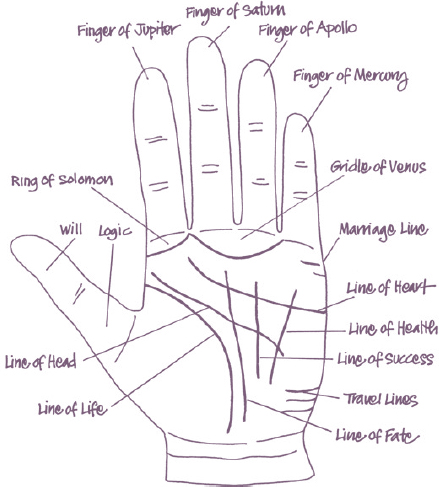
So, magnifying glass at the ready? Look at the hand picture higher up in this chapter to guide you to the most likely positions of the relevant lines listed below and to the diagrams of individual mounts and so forth in the earlier chapters.
For each line, mount, etc., on your profile, scribble under the heading (leave plenty of space under each entry) any significant features, any strengths and potential pitfalls.
The Profile Sheet
This can be written or printed and, if you wish, you can create a template for your Active hand.
Name:
Age:
Any special questions/issues that the reading could answer:
The Lines:
Heart line
Head line
Life line
Fate or Destiny line
Sun or Apollo line
Health line
Intuition line (optional)
Relationship/Marriage and Children lines if relevant
Any significant interactions formed by these lines:
The Mounts:
Mount of Jupiter
Mount of Saturn
Mount of Apollo
Mount of Mercury
Mount and Plain of Mars
Mount of Luna or the Moon
Mount of Venus
Any significant interaction between individual lines and mounts.
Fingers and Thumb:
Thumb
Jupiter, first or index finger
Saturn, second finger
Apollo, third or ring finger
Mercury, little finger
Any significant interaction between individual thumb, fingers, and mounts to which they relate.
Summary of strengths and weaknesses of the whole hand (Suggested action/improvements/changes in lifestyle related to the whole hand, to answer questions posed by the subject (remedies based on discussion with subject)):
In the next chapter, we will learn about the significance of markings on the hand.